The Building Blocks to Increase your Life Expectancy
Health is wealth, and to a lesser degree, wealth is health. In this post, I’ll draw parallels between investing and longevity, with a focus on the latter.
Let’s start with investing. At Quantos, we manage wealth, and a core principle we abide by is diversification. In investing, diversification helps improve the risk-return profile of a portfolio by combining different assets, strategies, or methods that each bring value. As long as each feature has a positive return and is not overly correlated with others, stacking them together increases the overall benefit. If you’d like to learn more about how we apply this at Quantos, feel free to enquire at our website.
On a personal level, we all manage our own health. Just like with investing, there are multiple ways to increase our lifespans (and healthspans). While the concept of diversification isn’t commonly discussed in longevity, I find the concept of stacking lifestyle habits to be very powerful. If these habits don’t overlap too much, they can work synergistically to maximize the benefits. This is the basis for the concept of “Longevity Stacking“ – a term I’ve coined as part of my approach to “Radical Optimisation”.
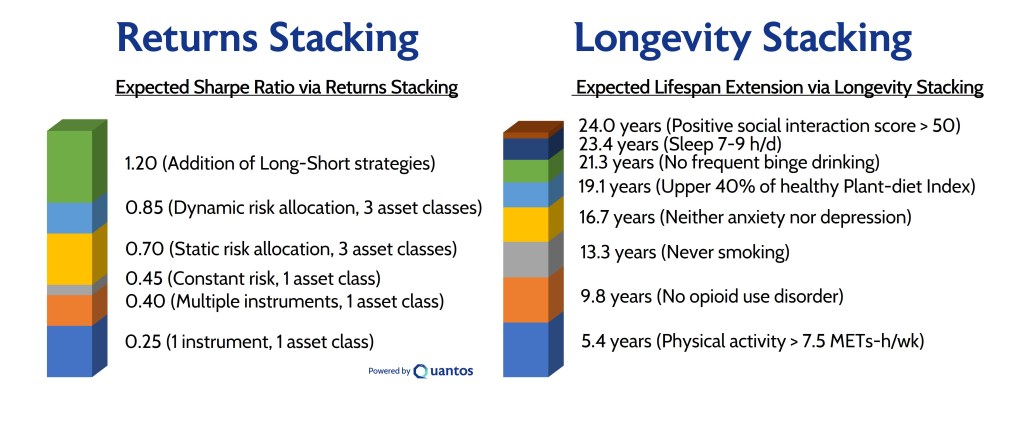
Let me illustrate the concept of Longevity Stacking with a study that examined how adopting 8 key lifestyle habits by age 40 could increase life expectancy by 24 years in men compared to those who didn’t adopt any of these habits. Similar results were found for women.
1. The study didn’t attribute a specific increase in life expectancy to each of the 8 factors, but it calculated a hazard ratio for each, showing how much each factor reduced the risk of early mortality. But by adopting all 8 factors, the study found a 24-year increase in life expectancy. I’ve used these hazard ratios to estimate the contribution of each factor and proportion the 24 years accordingly. While this is an approximation, it offers a useful way to visualize the impact of each factor.
2. I’ve sorted the factors by their strength (based on the reduction in hazard ratio), with the most impactful factor (exercise!) at the bottom of the stack. The number of years represents the cumulative effect of that factor and all the factors below it. By doing some simple calculations, you can isolate the impact of each individual factor (e.g., getting 7-9 hours of sleep daily adds approximately 2.1 years).
3. It’s never too late to start, but the earlier we adopt these habits, the greater the benefit. For example, while the 24-year increase applies to those who start at age 40, starting at age 50 results in a 21.3-year increase, and at age 60, it’s a 16.5-year increase.
Study: Impact of 8 Lifestyle Factors on Mortality and Life Expectancy Among United States Veterans: The Million Veteran Program, Nguyen et al.
 Longevity Stacking
Leave a comment